
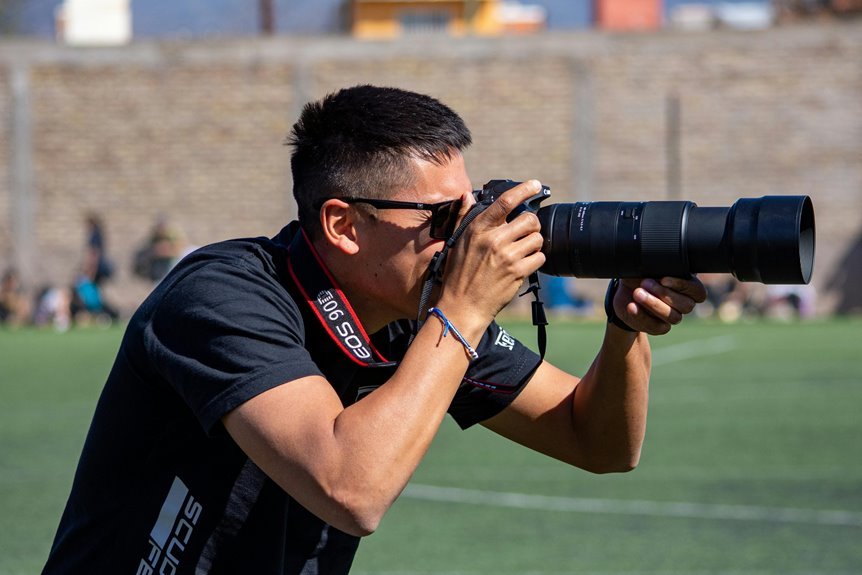

Action sports photography comes down to camera settings more than luck. A fast shutter speed freezes the action, while AF-C, the right focus area, and burst mode help you catch sharp, split-second shots. As light changes, aperture, ISO, white balance, drive mode, and metering keep your images clean and steady. Get these nine settings working together, and your keeper rate can rise fast.
Pick a Fast Shutter Speed for Action Sports
During the time you photograph action sports, shutter speed is the initial setting you need to lock in, because it controls whether the moment looks sharp or turns into a blur.
In case you want crisp action that feels worthy of the team, start around 1/500 second. For faster plays, move to 1/1000 second or higher. Golf swings often need 1/2000 second, and big peak moments can benefit from 1/3200 second in burst mode.
That choice connects directly to how your image feels. A slow shutter creates motion blur, which can look creative, but it won’t give you that clean, shared victory look most sports shooters chase.
Should you be unsure, use 1/640 second as a safe baseline, then raise it as the action gets quicker. You’ll feel more confident, and your photos will look like you belong trackside.
Use AF-C to Track Fast Subjects
Once you’ve set a fast shutter speed, your next job is keeping the athlete in focus from start to finish. That’s where AF-C helps you feel like part of the action, not left behind alongside it. Whenever a player runs, jumps, or cuts fast, AF-C keeps adjusting focus as the distance changes.
Because movement never stays simple, focus tracking works best whenever you place your starting point on the athlete at the outset and stay steady. Then your camera uses subject prediction to follow where that person is heading, not just where they were a split second ago.
You’ll get more keepers, especially during bursts, and that builds confidence fast. Should your subject briefly slips away, re-center and lock on again. With practice, AF-C starts to feel natural, and your timing feels more connected.
Pick the Right Focus Area Mode
After you set AF-C for motion, you need a focus area mode that can keep up with the action. Dynamic Zone Selection helps you hold focus as a player moves fast and briefly slips off your main point, while Subject Tracking modes let your camera follow that athlete across the frame.
Whenever you match the right mode to the sport, you’ll get more sharp shots and a lot less frustration.
Dynamic Zone Selection
Because fast action rarely stays in one spot, your focus area mode matters just as much as your shutter speed. Adaptive Zone Selection helps you stay connected during athletes shift suddenly across the frame.
Instead of trusting one tiny point, you give your camera a small group of points, which enhances focus adaptability and keeps your shots more reliable.
Use it well through matching the zone to the sport and your position:
- Choose zone customization that fits the scene, tighter for single players, wider for crowded action.
- Keep your active zone over the athlete’s chest or helmet, where contrast stays clear.
- Pair Adaptive Zone Selection with AF-C or AI Servo so focus updates as movement changes.
You’re not guessing here. You’re working like the group, ready for the next sharp moment.
Subject Tracking Modes
How do you keep focus once a player cuts hard across the frame and your carefully placed zone can’t stay on them? You switch to subject tracking modes. In the sports photo crowd, this is where your camera starts feeling like a real teammate. With AF-C active, tracking follows the athlete after you lock focus, even in case they dodge, turn, or sprint toward you.
That’s where subject recognition helps most. Your camera can identify people, helmets, cars, or animals, then stay glued to that subject through cluttered backgrounds.
In the event your camera offers eye detection, use it for close action, especially portraits, celebrations, or single-player moments. For faster, messier play, start with a wider tracking area so the camera has room to grab the target. Then trust it, keep panning, and stay with the play.
Use Burst Mode for Action Sports Photos
At the time you use burst mode, you give yourself more frames to choose from, so you’re far more likely to catch the exact instant the action peaks. It also helps you follow fast motion through a full sequence, in case you’re tracking a jump, a kick, or a swing.
To keep that speed working for you, you’ll need to balance frame rate with your camera’s buffer so it doesn’t slow down at the worst moment.
Maximize Frame Selection
Why leave your best shot to luck in case burst mode can catch the exact split second that matters most? At the moment you shoot action sports, burst mode gives you more choices, so you don’t have to hope one click lands perfectly. A higher frame rate records tiny changes in body position, ball placement, and expression, helping you choose the strongest image later with better image sharpness.
- You create a fuller story from one play, not just one guess.
- You feel more confident because you know you’ve covered the moment.
- You bring home options that make editing easier and more rewarding.
As a sports photographer, you belong in the fast pace of the game. Burst shooting helps you keep up with that rhythm, stay connected to the action, and select the frame that feels most alive afterward.
Track Peak Motion
Burst mode doesn’t just give you more frames to choose from. It helps you stay with the action like everyone on the sidelines who knows the big moment is coming.
Whenever you hold the shutter, you build a visual sequence that reveals tiny shifts in body position, timing, and expression.
That sequence sharpens your motion prediction. You start noticing at what point a sprinter lifts, at what point a skater turns, or at what point a rider reaches full extension.
With practice, burst shooting trains your peak anticipation, so you’re not reacting late. You’re following the rhythm and feeling part of it.
Keep your camera firing through the move, not after it. The best frame often lives between obvious moments, where effort, form, and emotion line up for the shot your community will instantly recognize and celebrate together.
Balance Buffer Speed
Speed matters, but buffer control keeps your camera ready for the next play. Whenever you hold the shutter too long, your camera can stall, and you miss the moment your team came to see. Burst mode works best whenever you shoot in smart, short bursts. That gives you strong action frames without choking the buffer.
- Use continuous shooting for peak motion, then pause to let the buffer clear.
- Choose RAW only whenever you need editing room. Large JPEG helps buffer management stay fast.
- Use fast cards for better memory optimization, especially whenever shooting 20 to 30 fps.
You belong on the sidelines with confidence, not stress. Whenever you balance speed and recovery, your camera stays responsive, your timing improves, and you capture the plays everyone remembers.
That rhythm helps you shoot like part of the action.
Open Your Aperture for Better Subject Separation
As you open your aperture wide, you make your athlete stand out fast and clearly against a softer, less distracting background. That look helps your photos feel more polished and more like the action images you admire.
Whenever you choose a wide aperture, often around f/2.8, you create stronger depth separation, so viewers lock onto the player, not the clutter behind them.
This matters even more on busy fields, packed courts, and crowded skate parks. You want your subject to feel like the hero of the frame, and a low f-stop helps you do that with confidence.
In case your lens only opens to f/4, don’t worry. You can still get clean subject isolation, especially whenever you move closer or keep more distance between your athlete and the background.
Raise ISO When You Need More Speed
How do you keep your shutter speed fast as the light drops or the action gets even quicker? You raise ISO. That extra sensitivity lets you hold 1/1000 second or faster, so your athlete stays sharp once the moment turns electric.
Start with a practical range, then push higher whenever needed. You’re not failing upon increasing ISO. You’re adapting like every skilled sports shooter does.
- In daylight, ISO 400 often works well for soccer or basketball.
- Indoors or at night, ISO 4000 to 5000 can protect speed and keep exposure strong.
- Trust modern sensor performance, then refine noise control later in case grain appears.
That balance matters. A slightly grainy image with crisp action feels alive and shareable. A blurry frame doesn’t.
As you raise ISO with purpose, you stay in the game.
Use Shutter Priority in Changing Light
Raising ISO helps you protect a fast shutter, and as the light keeps shifting, Shutter Priority gives you that same control with less stress. You choose the speed, and your camera adjusts the aperture as clouds pass, players move, or shadows cut across the field. That keeps you ready whenever the action changes fast.
In changing light, shutter priority helps you stay with the game instead of chasing settings. Start around 1/1000 second to freeze motion, then go faster for sports with quick swings or jumps.
In case the lens reaches its widest aperture and photos still look dark, raise ISO without guilt. You’re not guessing. You’re making smart choices that keep you in step with other shooters who know timing matters, and who trust simple settings whenever the pressure rises.
Adjust White Balance for Outdoor Sports
Consistency matters while you’re shooting outdoor sports, because white balance shapes the color of every frame just as much as shutter speed shapes motion.
In case your colors shift from cool to warm, your gallery feels scattered, not united. You want every image to feel like it belongs with the rest.
Start with Daylight in steady sun, then watch the light as clouds roll in or games stretch toward sunset. Auto white balance can drift, so set a specific color temperature whenever you need dependable skin tones and team colors.
Better yet, save custom presets for sunny fields, overcast parks, and stadium shade.
- Match white balance to the actual light, not the jersey color.
- Use RAW in case you want more room to fine tune later.
- Check the LCD often so your series stays true.
Choose the Right Drive and Metering Mode
Once your color stays steady, you need a drive mode and metering mode that can keep up with the speed in front of you. For action, choose continuous shooting from your drive modes so you catch the peak jump, tackle, or turn. You won’t feel left out as soon as the best frame happens fast. Pair that with smart metering methods. Evaluative or matrix metering works well whenever light shifts across the field, while spot metering helps when a bright jersey or sky fools exposure.
| Setting | Best use |
|---|---|
| Continuous High | Fast sequences |
| Pre-Capture | Unpredictable starts |
| Evaluative Metering | Changing light |
| Spot Metering | Backlit subjects |
These settings work with your shutter, aperture, and ISO choices, helping you stay ready, confident, and part of the action with every press.
Frequently Asked Questions
What Lens Focal Length Works Best for Different Sports?
Use a wide angle lens for tight, immersive views on a basketball court or at a skate park, a telephoto zoom for sports played across larger spaces like soccer or baseball, and a fast prime when you need extra reach, quick shutter speeds, and stronger subject isolation.
How Should I Position Myself on the Field or Court?
Stand near the baseline, sideline, or end zone where the view stays clear and the action remains in frame. Pick angles that separate the main subject from distractions, and read the flow of play so you can react before the moment happens.
Is RAW or JPEG Better for Sports Photography?
RAW gives your team more latitude to refine fast action in post processing, though the files take up more space. If quick delivery and simple sharing matter most, JPEG is the better fit.
How Can I Protect My Gear in Bad Weather?
Protect your gear in bad weather by using weatherproof covers, packing silica packs to manage moisture, drying equipment as soon as possible, and keeping spare cloths within easy reach. These steps help you stay ready when conditions turn rough.
What Accessories Are Most Useful for Action Sports Photography?
Monopods reduce fatigue during long sessions and keep framing steadier when tracking riders or racers. Lens hoods cut flare in bright outdoor conditions. Extra batteries prevent missed sequences in cold weather or extended burst shooting. Fast memory cards clear the buffer quickly during high frame rate bursts. Rain covers protect your camera when weather shifts or spray becomes a problem. These accessories support smoother shooting in fast moving conditions.