
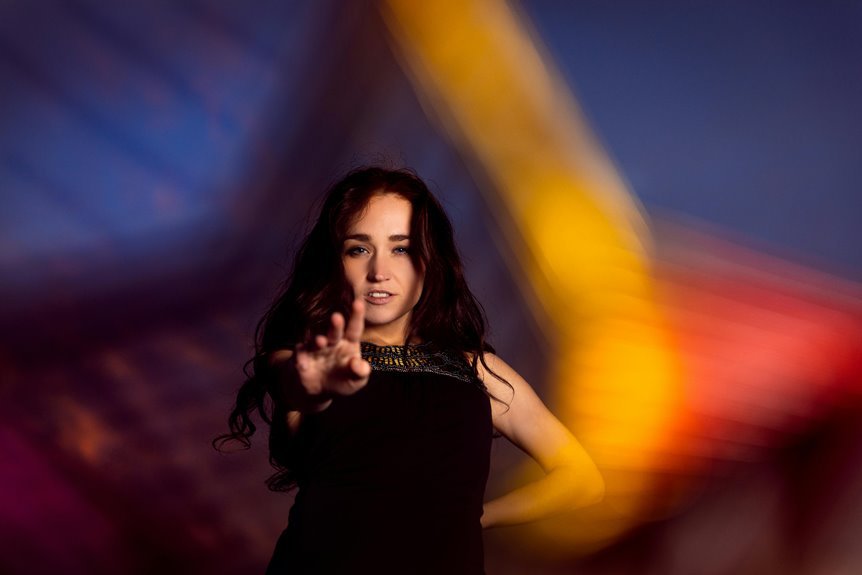

Clean background blur in an outdoor portrait comes from three things: distance, lens choice, and focus. Place your subject several feet away from trees, walls, or anything busy behind them. Use an 85mm or longer lens around f/2.8 to f/4 for sharp eyes and a soft, creamy background. Keep ISO low, use a steady shutter speed, and eye autofocus to hold the shot together.
What Creates Blur in Outdoor Portraits
Once you’re trying to get that soft, creamy background in an outdoor portrait, the blur comes from a few key choices working together, not just one magic camera setting. You’re not missing some secret club rule. It’s mostly about distance and lens behavior working in your favor.
Start with focal length. At the time you use a longer lens, your subject stands out more naturally, and the background looks softer.
Then move closer to your subject. That tighter framing makes the person feel present and connected, while the scene behind them melts away. Just as crucial, increase the background distance. Whenever your subject stands farther from trees, walls, or crowds, those details blur more easily.
Together, these choices help you create portraits that feel warm, polished, and welcoming, like your subject truly belongs in the frame.
Choose the Best Aperture for Portrait Blur
Once you choose a wide aperture, you get more blur, but you also give up some room for focus mistakes. You can control how much your subject stands out through adjusting your f-stop, often landing around f/2.8 to f/4 for a strong balance outdoors.
Most of all, you want your subject’s eyes sharp, because even the creamiest background won’t save a portrait provided the eyes aren’t clear.
Wide Aperture Tradeoffs
Although a very wide aperture can give you that soft, creamy background you love, it also makes your margin for error much smaller.
Whenever you shoot at f/1.4 or f/1.8, even a slight sway can put an eye soft and leave lashes sharper than the pupil. That’s frustrating, especially at the moment you want results that feel polished and shared-worthy.
Subject Separation Control
Because strong subject separation comes from more than just opening your lens all the way, the best aperture for portrait blur is usually the one that keeps your subject crisp while still letting the background fall away softly.
For most outdoor portraits, you’ll feel at home around f/2.8 to f/4, where blur looks clean and natural.
From there, control gets easier once you match aperture with distance and lens choice. In case you step closer and use 85mm or longer, you won’t need to force the widest setting. That gives you more room to balance subject lighting, exposure, and a flattering frame.
It also helps subject posing feel relaxed, because your setup supports the look instead of fighting it. Keep your subject farther from the background, check your preview often, and you’ll create separation that feels polished and welcoming.
Sharp Eyes Priority
How do you get dreamy background blur without losing the most vital detail in the frame? You keep your eyes on the eyes. For outdoor portraits, start around f/2.8 to f/4. That range gives you soft blur while keeping both eyes sharp more often, especially in cloudy light.
In case you’re tempted with f/1.4, slow down and check focus accuracy, because tiny misses show fast.
As you dial aperture, pair it with eye tracking so your camera stays locked where connection lives. That helps you create portraits that feel polished and welcoming, not accidental.
- Use Aperture Priority mode so you can control blur quickly.
- Choose f/2.8 to f/4 for a safer sharpness sweet spot.
- Step closer, and keep your subject farther from the background.
- Review shots often, because even great light can’t rescue soft eyes.
Keep Eyes Sharp at Wide Apertures
During the moment you shoot at wide apertures like f/2.8 or wider, keeping the eyes sharp becomes the part that matters most, since a very shallow depth of field can make the eyelashes crisp while the eyes turn soft. So, join the habit of placing your focus point on the near eye. Should autofocus hunts, switch to manual focus. Stay steady, use 1/200 or faster, and ask your subject to pause and breathe gently.
| Do this | Why it helps |
|---|---|
| Single-point AF | Targets the eye |
| Burst mode | Catches tiny movements |
| Slight stop-down to f/3.2 | Gives safer sharpness |
| Focus stacking | Rarely practical for portraits |
As you practice, you’ll feel more confident and connected with other portrait shooters who know that sharp eyes make every blurred background feel intentional.
Use a Longer Lens for Smoother Blur
Assuming you want that soft, creamy background, a longer lens often helps more than people expect. Once you switch to an 85mm or longer focal length, your portrait can feel more polished right away. You’ll notice smoother blur, plus flattering lens compression that makes the scene feel calm and connected.
That’s why so many portrait photographers reach for longer lenses as they want images that feel welcoming and professional.
- Choose 85mm, 105mm, or longer for softer-looking backgrounds.
- Zoom in on your lens instead of staying at the widest view.
- Pair that longer focal length with a wide aperture for even better blur.
This approach also helps your subject stand out without looking cut out. You’re creating portraits that feel natural, warm, and beautifully together, like your subject truly belongs in the frame.
Move Your Subject Away From the Background
Should you want stronger background blur, move your subject farther away from whatever is behind them. You’ll get a cleaner, softer look once you place open space behind them instead of a nearby wall, tree, or bush.
Even a few extra steps can make your subject stand out more, and that’s often the easiest fix in outdoor portraits.
Increase Subject-Background Distance
Because background blur depends on distance as much as aperture, one of the easiest ways to make your subject stand out is to move them farther from whatever is behind them. Whenever you increase background distance, your camera separates your person more clearly, creating natural blur amplification without changing settings.
That means you can keep your portrait feeling clean, soft, and welcoming.
As you frame the shot, guide your subject a few steps forward and watch the scene evolve. You’ll notice stronger separation and a more polished look that helps your subject feel like they belong in the spotlight.
- Move them farther from walls, trees, or fences
- Check how the background softens after each small step
- Pair this with your chosen aperture for even smoother blur
- Keep your subject relaxed, because comfort shows in every portrait
- Make small adjustments together and enjoy the progress
Use Open Space Behind
Another smart step is to place open space behind your subject, not just a nearby background. Whenever you do this, you give blur room to breathe, and your portrait feels cleaner right away. Instead of standing someone against a wall, bush, or fence, guide them several steps forward. Then let the distance work for you.
This matters even more with natural backgrounds. A faraway line of trees, a field, water, or sky will melt more smoothly than leaves pressed close behind your subject. You’ll also avoid busy shapes that pull attention from their face.
As you frame the shot, look for gaps, depth, and calm color behind them. That open space helps your subject stand out in a way that feels polished, welcoming, and easy to love, like they truly belong there naturally.
Step Closer for More Background Blur
Move in closer, and you’ll usually see the background melt away faster than you expect.
At the point you use closer proximity to your subject, your camera separates them from the scene more easily, creating a natural blur increase without changing other settings. It’s one of the simplest ways to make portraits feel polished and intimate.
That small step forward also helps your subject feel more present, like they truly belong in the frame and in the moment with you.
As you fill more of the frame, distant trees, paths, or buildings soften beautifully.
- Take one or two small steps forward, then compare the background.
- Keep your subject comfortable, since connection matters as much as technique.
- Test a few distances, because even a slight move can change the look in a lovely way quickly.
Set Shutter Speed for Sharp Outdoor Portraits
As you move in closer for more blur, your shutter speed becomes even more crucial to keeping your subject sharp. You’ll want to match it to how much your subject is moving, and for handheld shots, staying around 1/200 to 1/500 second often helps you avoid blur from camera shake.
At the same time, you need to balance light and background blur, so your photo stays crisp without losing that soft outdoor portrait look.
Match Subject Movement
Even with a beautiful blurry background, your portrait won’t feel right should your subject look soft from motion, so shutter speed has to match how much they’re moving.
In case they’re standing calmly, you can often stay around 1/125 to 1/250. In the event they’re talking with their hands, turning, or laughing, go faster for better motion freeze and a more confident result.
Because you want portraits that feel polished and welcoming, watch for blur anticipation before you press the shutter. Small movements matter outdoors, especially during moments everyone’s relaxed and natural.
- Use 1/250 for gentle movement like talking or swaying.
- Try 1/500 if your subject is walking, tossing hair, or playing.
- Take a quick test shot, then zoom in and check the eyes.
- As energy rises, raise shutter speed initially so your subject still feels fully present.
Use Handheld Safe Speeds
While aperture shapes your background blur, shutter speed protects the sharp detail that makes a portrait feel alive in your subject’s eyes and face.
Whenever you’re shooting handheld, start around 1/200 sec, and move to 1/250 or 1/500 should your lens be longer or your hands feel unsteady. That gives you a reliable comfort zone, so you can stay present with your subject instead of worrying about blur.
In case your camera offers camera stabilization, use it, but don’t trust it to freeze every tiny movement. Your subject still shifts, smiles, and breathes. That’s why safe shutter speeds matter so much outdoors.
And provided the light drops, tripod use can help, though portraits usually feel more natural when you can move, connect, and keep the moment easy. Consider shutter speed as the steady friend in your setup.
Balance Light And Blur
Because outdoor portraits ask for both soft blur and crisp eyes, your shutter speed has to protect sharpness without stealing the light you need. Start around 1/200 to 1/500 sec once you’re shooting wide open outdoors, then adjust for your subject’s movement and your lens length.
In variable lighting, keep checking highlights so bright skin doesn’t wash out. Should the scene shift, use exposure compensation to hold a natural look while keeping blur.
- Choose 1/250 sec or faster in case your subject sways, laughs, or turns.
- Drop toward 1/125 sec in soft cloudy light once your hands are steady.
- Raise shutter speed with longer lenses, since blur from shake shows sooner.
- Keep ISO low initially, then fine tune shutter speed before closing aperture.
That way, you stay in control and your portraits feel polished, warm, and beautifully yours.
Keep ISO Low for Cleaner Outdoor Portraits
In case you’re shooting outdoor portraits, keeping your ISO low is one of the easiest ways to get cleaner, smoother images that still feel soft and polished. You’ll usually get the best results at ISO 100, or as low as your camera allows. That simple choice helps with noise reduction, keeps skin tones natural, and improves color accuracy, which matters whenever you want portraits that feel warm and true to life.
As you work with soft outdoor light, a low ISO gives your image a calmer, more refined look. It also protects fine detail in hair, eyes, and fabric. Should the scene feel too bright or dim, adjust shutter speed or aperture initially before raising ISO.
That way, your portraits stay crisp, flattering, and beautifully clean, just like the kind of images you’re proud to share.
Choose Eye Autofocus for Outdoor Portraits
During the moment you’re shooting outdoor portraits, eye autofocus can save you from the most frustrating mistake of all: getting a beautiful shot that looks soft where it matters most.
Whenever your lens is wide open, even a tiny focus miss shows. That’s why you’ll feel more confident using eye detection with face tracking.
It helps your camera stay locked on your subject’s nearest eye, even in case they shift, laugh, or turn slightly. In other words, you stay part of the moment instead of fighting your settings. Set focus priority so the camera favors sharp focus before taking the shot.
- Use continuous autofocus for small movements.
- Choose the nearest eye for a natural portrait look.
- Check focus after a short burst.
- Pair eye autofocus with a wider aperture carefully.
- Keep your subject relaxed so tracking works better.
Handle Bright Sun and Busy Backgrounds
As bright sun and a messy background start competing with your subject, your job is to simplify the frame so the face still feels like the clear center of attention. Start by moving your person into open shade or turning them so the sun lights from behind. Then use ND should you want to keep a wide aperture like f/2.8 without overexposing the shot.
Next, create separation. Step closer, zoom longer, and place your subject farther from trees, cars, or signs. That gives you softer blur and fewer distractions.
In case the face looks dark, gentle reflectors usage can lift shadows and keep skin natural. Also, watch the edges of your frame. Small shifts left or right can remove bright patches and clutter.
As you guide these choices, your portraits feel calmer, cleaner, and more welcoming.
Frequently Asked Questions
Can Wind Affect Outdoor Portrait Sharpness and Blur Consistency?
Yes, wind can reduce portrait sharpness and make background blur look uneven. It often shows up as small subject movements, shifting hair, and motion blur. To keep results more consistent, stabilize the pose, use a faster shutter speed, and move in closer.
Should I Use a Lens Hood for Outdoor Portraits?
Yes, use a lens hood for outdoor portraits. It cuts flare, improves contrast, and adds some protection for the front of the lens. It is especially useful when the sun shifts, light reflects from nearby surfaces, or wind kicks up dust outdoors.
How Does Shooting RAW Help With Outdoor Portrait Editing?
Shooting RAW gives you wider tonal range and adjustable white balance, letting you recover bright areas, open up shadows, and refine skin tones with more precision so outdoor portraits look clean, natural, and consistent with your editing style.
What Should My Subject Wear for Better Background Separation?
Wear clothing that contrasts with the background and has enough texture to catch light in a flattering way. Solid colors usually photograph more clearly than loud patterns, and shades that differ from nearby trees, grass, brick, or painted walls help your subject stay visually distinct.
When Is a Reflector Useful for Outdoor Portrait Sessions?
A reflector helps when daylight needs direction, especially in open shade, backlit scenes, or patchy sunlight. It softens shadows, adds catchlights to the eyes, and gives faces a more balanced, flattering finish.